IBM announcements have a habit of arriving wrapped in enough product names, feature codes, technology refreshes, and carefully capitalized nouns to make an ordinary human reach for a decoder ring. This one is worth decoding.
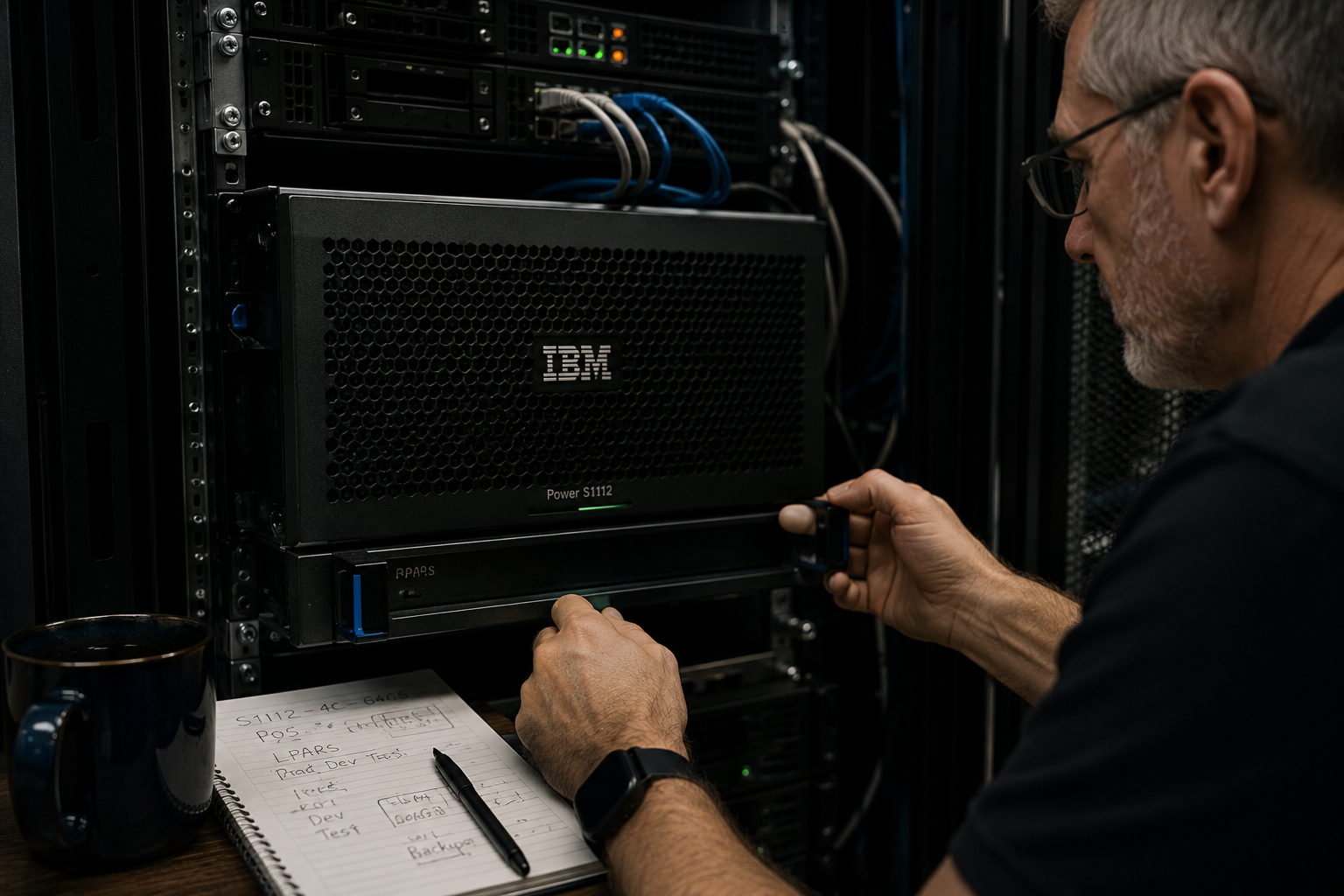
The IBM Power S1112 became generally available on July 24, 2026. It is a compact, one-socket Power11 server aimed at entry-level workloads, including IBM i environments in the P05 software tier. IBM is offering rack-mounted and deskside versions, because some AS400 shops have a proper data centre and others have a server room that also stores toner, Christmas decorations, and one mysterious cable nobody is allowed to throw out.
I pay attention to this stuff because I have been programming RPG since I was twelve. While other kids were trading Pogs and arguing about whether the Super Nintendo was better than the Genesis, I was learning about printer files, job queues, records, reports, and the strange beauty of business systems that did exactly what they were told without demanding a software subscription for each button.
I have watched IBM’s definition of “entry-level” change several times. The Power S1112 is interesting because it gives smaller IBM i shops access to current Power11 hardware while preserving the P05 boundary that makes the licensing economics possible in the first place.
And when I say “small IBM i shop,” remember that small is relative. A small AS400 can still run every order, invoice, inventory transaction, shipment, customer record, and month-end process for a company with serious revenue and dozens or hundreds of employees. The box may sit quietly in the corner. The business certainly notices when it stops.
What IBM actually announced
Here is the useful version without the full IBM brochure experience:
| Item | IBM Power S1112 |
|---|---|
| Processor generation | Power11 |
| Physical design | One socket; rack or deskside |
| IBM i software tier | P05 |
| IBM i capacity boundary | Up to 4 cores and 64 GB memory |
| IBM i partitions | Up to 4 IBM i LPARs within that boundary |
| Whole-system capacity | Up to 10 cores and 512 GB memory |
| Additional operating systems | Linux, AIX, or VIOS can use resources beyond the IBM i boundary |
| Internal NVMe storage | Up to 12.8 TB raw; IBM i mirroring limits usable internal capacity to 6.4 TB |
| General availability | July 24, 2026 |
IBM i 7.6 TR2, IBM i 7.5 TR8, and IBM i 7.4 TR12 with the required PTF provide support for the new server. IBM’s documentation also confirms that additional processor and memory resources beyond the IBM i P05 boundary can be assigned to Linux, AIX, or VIOS workloads.
The IBM i side of the machine remains inside four cores and 64 GB. The four-LPAR capability does not mean four partitions each receiving four cores and 64 GB, because that would be a very different announcement and several licensing people would need to lie down. It means you can divide the IBM i environment across as many as four partitions while staying inside the P05 boundary.
That is enough for some genuinely useful separation. A company might maintain production, development, testing, and another isolated workload on the same machine. It is still one physical machine, however. Four LPARs in one chassis are four rooms in the same house. They are not disaster recovery if the house loses power.
P05 is the real story
Power11 performance is nice. P05 economics are the reason many smaller IBM i customers will care.
IBM says the S1112 delivers twice the per-core performance of a four-core Power S914 and three times the per-core performance of a four-core Power S814, based on IBM’s published CPW comparisons. IBM also claims up to 69% better performance per watt than an S914 using an extrapolated ten-core S1112 figure. Those are IBM’s numbers and IBM’s methodology, so treat them as useful directional information rather than tablets carried down from Mount Armonk. Your actual workload still gets a vote.
The per-core comparison matters because IBM i shops do not buy abstract processor enthusiasm. They buy enough licensed capacity to run a workload. More commercial workload performance inside the same P05 software boundary can mean a substantial improvement without stepping into a higher IBM i software tier.
That does not make the S1112 cheap by magic. IBM has not suddenly become Costco. Memory, storage, software, support, migration, licensing, and surrounding infrastructure still need to be configured properly. The interesting part is that a P05 customer can now buy current Power11 technology without automatically buying a machine designed for a workload several times larger than the one it actually has.
We recently wrote about why the AS400 itself is not necessarily expensive, while buying it blindly absolutely is. The S1112 does not change that argument. It gives IBM i shops another genuinely useful option, which makes proper workload analysis more important rather than less.
A good server choice comes from understanding current CPU demand, memory pressure, peak batch windows, storage growth, partition requirements, software licensing, recovery expectations, and where the business is heading. “It says Power11 on the front” is not capacity planning.
The hybrid architecture is weirdly useful
The most interesting architectural detail may be what happens outside the IBM i boundary.
IBM i is confined to P05, but the full S1112 can be configured with as many as ten cores and 512 GB of DDR5 memory. Additional resources can support Linux, AIX, or VIOS on the same physical system. IBM is also positioning the S1112 for local AI inference through Power11’s on-chip Matrix Math Acceleration hardware.
That opens up a useful pattern for the right organization:
- IBM i remains the stable transactional core and system of record.
- A Linux partition can host APIs, integration middleware, monitoring, development tools, or selected open-source services.
- A modern web or mobile application can talk to the IBM i through a controlled service layer.
- Local AI inference can sit close to operational data when privacy, latency, or data movement makes that sensible.
- Development and testing workloads can be separated from production without immediately requiring another physical server.
This is where enterprise integration becomes more interesting than another vague modernization project. A company may not need to replace the RPG application that runs inventory, pricing, orders, or manufacturing. It may need a modern API layer, better reporting, a web interface, automated data movement, or a Linux-based service that lets newer systems interact with the IBM i cleanly.
We have argued before that AI should go where the work gets messy, surrounded by ordinary deterministic software that handles records, quantities, permissions, and audit trails. The S1112 makes local inference a plausible architectural option for some businesses, especially where data locality matters.
“AI-ready” still requires a real workload.
Please do not buy extra Power11 capacity because the brochure said AI and then ask the machine to summarize meeting notes. A laptop can do that without requiring a migration plan and a person who knows what an LPAR is.
The better possibilities involve tightly bounded inference close to business data: classifying operational notes, interpreting inconsistent product descriptions, extracting structured fields, supporting internal search, or helping staff work through complex but controlled workflows. Whether the MMA hardware, model ecosystem, available memory, and operating-system support fit a particular use case needs to be validated before someone begins speaking excitedly about transformation.
AI-ready is a capability.
Architecture is deciding whether anybody should use it.
The fine print is where the adults live
The four-core and 64 GB IBM i boundary deserves careful attention. If your IBM i workload already needs more than that, the S1112 is not going to become suitable through optimism. Look at the S1122, S1124, Power Virtual Server, or another architecture that matches the actual requirement.
Storage also has a boundary. IBM lists up to 12.8 TB of internal NVMe, but IBM i partitions require mirrored storage, leaving 6.4 TB of usable internal capacity for IBM i. That may be plenty for many entry shops. It may be nowhere near enough for others. The number on the product page is not the same thing as the usable number in your configuration.
Partition management matters too. IBM supports Virtual Partition Manager as an alternative to an HMC for multi-partition configurations, but IBM i client partitions managed through VPM do not support dynamic logical partitioning. If you expect to move processor or memory resources around dynamically, the management design needs more thought than “we can probably do it later.”
There is also an operating-system nuance worth catching. IBM i 7.4 TR12 can support the S1112 with the specified PTF, but IBM i 7.4 moves from standard support into service extension on October 1, 2026. Compatibility with brand-new hardware does not automatically make 7.4 the sensible long-term destination for a new deployment. A shop buying Power11 should have an explicit release plan for 7.5 or 7.6 unless a real application constraint dictates otherwise.
This is the sort of detail that gets lost when buying decisions are reduced to processor generation and monthly payment. The server is only one component. Operating-system lifecycle, application compatibility, licensed products, development tools, backup strategy, HA/DR, external storage, networking, and staff knowledge all travel with it.
IBM can deliver a very capable box.
It cannot make your old vendor answer the phone.
IBM i 7.6 TR2 and 7.5 TR8 matter too
The S1112 did not arrive alone. IBM announced it alongside IBM i 7.6 Technology Refresh 2 and IBM i 7.5 Technology Refresh 8, and those updates make the broader story more credible.
Both technology refreshes add support for the new server. They also include new and enhanced Db2 for i and IBM i Services, including SQL facilities for CVE information, PTF currency, audit journals, system status, jobs, disk information, and generating spreadsheets. IBM has also added Virtual Ethernet Multi-Queue support, allowing network processing to be distributed across multiple processor cores instead of remaining constrained to one.
IBM i Migrate While Active continues to improve as well. The current updates add more replication choices, including supported external-storage methods such as FlashCopy and Global Copy, along with planning and user-experience improvements intended to reduce disruption during migrations and maintenance. That matters when an organization’s acceptable outage window is measured in uncomfortable conversations rather than hours.
On IBM i 7.6, the security work includes external key-management integration, Bring Your Own Key capabilities, master-key protection enhancements, and cluster support for MFA-enabled profiles. Navigator for i now includes multi-system CVE information, while ACS and BRMS continue receiving practical administrative improvements.
None of these features will generate the attention of a shiny new processor. They are the sort of improvements experienced IBM i shops actually need: migration options, security visibility, operational tooling, network performance, and better ways to query what the system is doing.
The platform may still present a green screen when you ask nicely. Underneath, it is not a beige Packard Bell with a Turbo button.
Modern IBM i development is no longer an oxymoron
The technology refresh documentation also includes substantial updates around the Code for IBM i ecosystem. IBM highlights MFA support, SSH key passphrases, improved security checks, a new environment view, better SQL execution through Mapepire, RPG and CL editor enhancements, testing improvements, filesystem tooling, debugging fixes, and deeper QSYS object support.
This matters because the IBM i skills problem is partly a tooling problem.
A younger developer who is used to VS Code, Git, automated testing, modern source organization, terminals, and sane navigation should not have to abandon all of that at the door and pretend SEU is the final form of human-computer interaction. There is value in the older tools and plenty of people remain extremely productive with them, but onboarding new developers becomes easier when IBM i can participate in modern development practices.
We have supported and developed AS400 and IBM i systems while also building modern applications, web interfaces, APIs, Linux services, and integrations. The useful modernization path often brings those worlds together instead of demanding that one side erase the other.
IBM is also pushing IBM Bob Premium Package for i, an AI-assisted development environment with IBM i-specific modes. IBM says it can work with RPG, CL, DDS, SQL, QSYS source members, IFS files, IBM documentation, test planning, business-rule extraction, and modernization workflows when it is given controlled access to an IBM i environment. It is a separate product, rather than a magical assistant included free because you bought the server.
“IBM Bob” sounds less like an AI agent and more like the guy who wrote the original order-entry program in 1997 and still knows why field CUSFLG7 must never be blank. Honestly, that may be perfect branding.
IBM Power Autonomous Operations is another separate offering, expected to become generally available on September 23, 2026. IBM says it uses an embedded agent to help monitor and resolve Power capacity issues, with human approval retained for remediation in IBM’s published test scenario. The S1112, Bob Premium, and Autonomous Operations arrived in the same announcement package, but they are distinct products. Do not let announcement soup turn into an assumption that every AI feature is inside the chassis waiting for someone to type GO AI.
The S1112 is a very good answer to some problems
A P05 IBM i shop running an older S814 or S914 should look closely. So should organizations approaching a hardware refresh, companies that need better single-core performance, and businesses that want to run a stable IBM i core alongside Linux-based integration or local inference workloads.
The S1112 may also suit organizations with several modest IBM i partitions, provided the entire IBM i estate fits within the four-core and 64 GB boundary. Production, development, testing, and a separate utility partition could be a useful arrangement. Again, that is workload separation rather than disaster recovery. Same power supply, same chassis, same opportunity for the universe to become involved.
A newer Power10 customer with plenty of capacity may have no urgent reason to move. A shop requiring more than four IBM i cores, more than 64 GB for IBM i, substantial internal storage, sophisticated dynamic partitioning, or complex HA requirements should look beyond the entry model.
Some businesses will discover that hardware was never the real problem. Their pain may come from manual exports, inaccessible data, undocumented RPG logic, poor reporting, unsupported releases, or systems that do not talk to one another. A Power11 server will run the same awkward business process much faster, which is certainly an achievement but probably not the one the CFO thought they were buying.
That is why the best developer is often the one asking about the warehouse. Hardware decisions should begin with how the business operates, where time is being lost, what staff depend on, and which problems actually need solving.
Sometimes the answer is new Power hardware.
Sometimes the answer is a ten-line script and a conversation accounting has been trying to schedule for six years.
Questions I would answer before ordering one
Before anyone signs a Power S1112 configuration, I would want clear answers to these:
- What is the current and peak workload, measured rather than remembered?
- Does IBM i fit comfortably within four cores and 64 GB throughout the planning horizon?
- How much internal storage is actually usable after protection and mirroring?
- How many partitions are needed, and what isolation is each partition supposed to provide?
- Will VPM be sufficient, or does the management model require HMC and dynamic resource movement?
- Which IBM i release and licensed products will run on the new machine?
- What is the migration method, outage window, rollback path, and recovery plan?
- Which workloads genuinely belong on Linux, AIX, or VIOS beside IBM i?
- Does local AI inference solve a real data, latency, or privacy problem?
- How will the system be backed up, monitored, patched, secured, and supported after the launch project is over?
This is business analysis applied to infrastructure. The goal is to connect the IBM configuration to the business rather than buying a collection of feature codes and discovering afterward that half the assumptions were wrong.
A proper plan should also look beyond the machine. Enterprise integration, modern development practices, application support, release planning, identity, networking, backups, and disaster recovery can matter as much as the processor.
The server should fit the business.
The business should not have to cosplay as the server configuration.
Why PANDAROSE is paying attention
The Power S1112 sits directly in the overlap where PANDAROSE does its best work.
We understand IBM i and RPG from inside the environment. We also understand Linux, web applications, APIs, custom software, modern source control, AI workflows, networking, managed infrastructure, and the operational processes around the system. That combination matters because most IBM i modernization projects are no longer purely IBM i projects.
The RPG application may remain the core. A new customer portal may need its data. A Linux service may expose a controlled API. An AI-assisted workflow may interpret messy operational input before passing clean data into Db2 for i. A modern development team may need Git, VS Code, automated tests, and repeatable deployments. Management may need reporting that does not begin with “export this file and ask Sharon which version is real.”
Our AS400 and IBM i support services cover platform support, RPG and CL development, long-term planning, and connecting legacy systems to modern applications. Our technical consulting and integration work help determine whether the right answer is a hardware refresh, an operating-system upgrade, a development modernization project, a Linux partition, a cloud architecture, or a much smaller change that removes the actual bottleneck.
We like IBM i because it is extremely good at certain jobs. We also know that “IBM can do it” and “your business should pay for it” are separate statements.
The S1112 looks like a serious new option for P05 shops. It offers current Power11 performance, flexible non-IBM i capacity, modern storage, a healthier development ecosystem, and a credible path for placing newer services beside the stable business core.
The green screen may still look like it belongs near a fax machine, a cassette deck, and your Blockbuster membership card.
Underneath it is Power11.
Pay attention.
If you are trying to determine whether the Power S1112 fits your IBM i workload, talk to PANDAROSE. We can review the current system, licensing boundary, release level, workload, storage, partitioning, migration risk, integrations, development practices, and where the business is actually trying to go before the quote becomes architecture by default.
Frequently asked questions about the IBM Power S1112
Is the Power S1112 an AS400?
“AS400” is the older name people still commonly use for the platform family. The S1112 is a current IBM Power11 server capable of running IBM i, AIX, Linux, and VIOS. IBM i is the current operating-system name. The green-screen lineage is real; the hardware is thoroughly modern.
How many IBM i partitions can the S1112 run?
IBM supports as many as four IBM i LPARs on the S1112. The IBM i environment remains within the P05 boundary of four processor cores and 64 GB of memory.
Can the S1112 run Linux beside IBM i?
Yes. Additional processor cores and memory beyond the IBM i boundary can be used for Linux, AIX, or VIOS, up to the server’s total capacity of ten cores and 512 GB.
Which IBM i releases support the S1112?
IBM i 7.6 TR2 and IBM i 7.5 TR8 support the S1112. IBM i 7.4 TR12 can also support it with PTF MJ08663, although IBM i 7.4 enters service extension on October 1, 2026.
Is the Power S1112 suitable for every small IBM i shop?
Its fit depends on workload, memory, storage, partitioning, release compatibility, licensing, recovery requirements, and growth plans. Any IBM i environment that requires more than four cores or 64 GB needs another platform or architecture. A sizing and application review should come before the order.