Most businesses are still using AI in the least interesting way possible.
They are using it to make bad work faster. Faster emails, faster summaries, faster social posts, faster reports, faster code, faster “strategy documents” that look official because they have headings and a table. Somewhere along the way, everyone decided that polished output meant useful output, which is a very convenient mistake if your goal is to fill a meeting agenda and a very dangerous mistake if your goal is to run a business.
AI can make weak work look respectable. That may be its most dangerous feature. Unqualified people can better hide their lack of experience and knowledge behind pretty tables and more cleaned up language.
It can also make strong work dramatically stronger. That is the part I care about. Smart people can increase their productivity by factors of 10, 20 or even more once they understand how to use it properly.
The difference is the person, the process, and the system around it. A capable person using AI well can run more scenarios, test more ideas, compare options, write cleaner documentation, generate useful first drafts, review code, find edge cases, summarize messy information, and get to the important judgment calls faster. The human still owns the result. The human still has to know when the answer smells wrong. AI just moves a lot of the sludge out of the way.
That is the force multiplier.
A lot of companies are treating AI like a cheap replacement for people. I think that misses the point. The better use is making good people more dangerous in the productive sense. More reach. More context. More passes. Better preparation. Less time burned on the parts of work that are necessary but not especially intelligent.
AI gives you leverage. Leverage is wonderful when it is attached to something solid. It is hilarious in the bad way when it is attached to wet cardboard.
A crutch or a jet engine
A crutch helps you limp. A jet engine changes the battlefield. Both are forms of assistance, but nobody confuses the two unless they are trying to sell you a webinar.
A lot of AI use right now is crutch behaviour. Someone asks AI to write something they do not understand, summarize something they did not really read, generate code they cannot evaluate, or produce a plan they do not have the experience to judge. The result often looks finished enough to pass casual inspection. It may have bullet points. It may have a confident tone. It may even include a nice little implementation roadmap, because apparently nothing says “I know what I’m doing” like a Phase 1 / Phase 2 table.
The problem is that getting an answer is not the same thing as understanding the problem.
This is where AI can quietly make people weaker. If someone uses it to avoid thinking, they get dependent on the shape of answers without developing the judgment to evaluate them. They become faster at producing work-shaped objects. The output looks like work. It travels through the organization like work. Then some poor person downstream has to clean it up, correct it, or explain why the confident paragraph was wrong in three different systems.
On the other hand, when a skilled person uses AI, the tool changes character. It becomes a jet engine. The same person can do more exploration, more checking, more drafting, more documentation, and more refinement. They can spend less time grinding through repetitive passes and more time deciding what the work should actually become.
That distinction matters because AI does not remove judgment from the process. It increases the amount of output that judgment has to govern.
The research is useful, but it is not a magic permission slip
The productivity gains around generative AI are real. Nielsen Norman Group summarized research suggesting an average productivity improvement of 66% across selected business tasks using AI tools. The NBER paper Generative AI at Work found a 14% average productivity increase in a large customer-support setting, with the biggest gains showing up among less experienced workers. Those numbers are not nothing. They explain why AI is not going away. Nielsen Norman Group and NBER
But the research is also more interesting than “AI makes everyone better.” MIT Sloan covered research showing that skilled workers can see major gains when AI is used within the boundary of what it does well. That boundary phrase matters. BCG’s work on the “jagged technological frontier” is also important here: people can create value with AI in tasks where the tool is strong and lose value when they trust it in places where it is weak. MIT Sloan, BCG
That fits what I see in real work. AI is not uniformly good or uniformly bad. It depends where you put it. It depends who is using it. It depends whether the output is reviewed by someone with actual knowledge. It depends whether the business has any discipline around data, privacy, quality, and workflow.
Harvard Business Review has also covered the uncomfortable side: AI can improve productivity while affecting motivation and the nature of work itself. Microsoft Research has looked at how generative AI changes critical thinking effort in knowledge work. Again, this tracks with reality. The tool can make people faster, but speed without judgment is not a win. Harvard Business Review, Microsoft Research
The useful conclusion is boring and important: AI works best when it is placed carefully inside real work.
Which brings us to the part most businesses are still missing.
Chatbots are not the whole story
The public version of AI is still mostly a chat window. Type a thing, get a thing. Ask a question, get an answer. Have it rewrite an email, summarize a meeting, draft a post, explain a spreadsheet, or produce a paragraph that sounds like every other paragraph on the internet.
That is useful, but it is the surface layer.
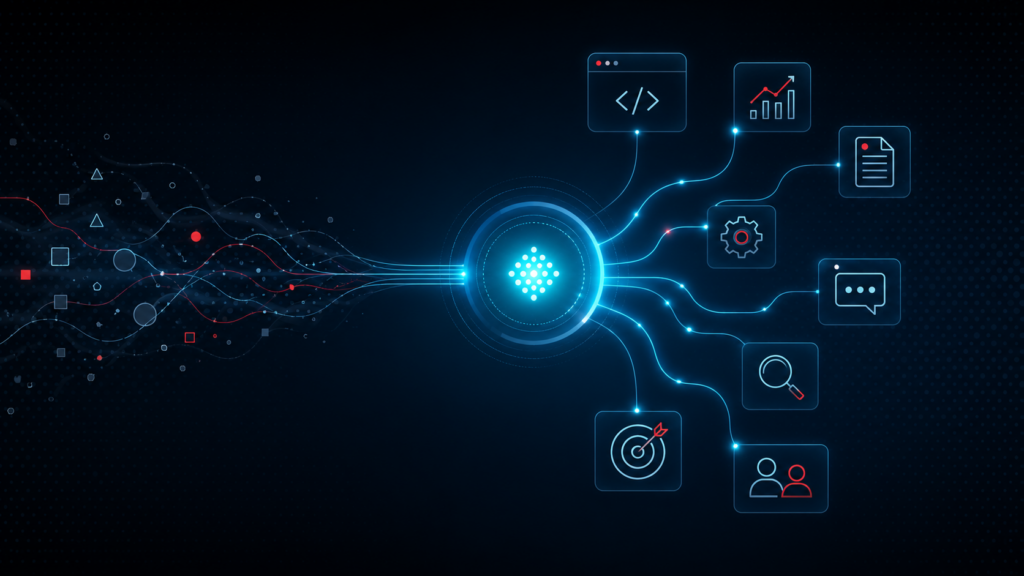
The more interesting work is agentic AI: AI systems that can operate inside a workflow, use tools, keep track of state, call functions, check intermediate results, hand work off, ask for clarification, and return structured output into ordinary software. OpenAI’s current agent documentation describes agents in terms of instructions, tools, state, guardrails, handoffs, and human review, which is much closer to software architecture than chatbot novelty. OpenAI Agents SDK
This is where things start to matter for businesses.
A chatbot sitting beside your workflow is often just another place to copy and paste. An AI component inside the workflow can classify messy input, extract useful structure, route information, draft a next action, summarize history, flag uncertainty, and hand clean data back to the actual system.
The key is knowing where AI belongs.
If the rule is clear, write the rule. If the calculation is deterministic, calculate it. If the database query is straightforward, query the database. If the workflow has three obvious states, please do not summon artificial intelligence like you are opening a portal over New York.
There is nothing mystical about this. The engineering question is where interpretation belongs and where ordinary deterministic software should keep doing its job.
AI should sit where the work gets messy
This is the part I wish more people understood.
AI is valuable when the input is messy, contextual, inconsistent, ambiguous, or hard to reduce to a clean decision tree without creating some monstrous expert system that nobody wants to maintain. Ordinary software is still better for permissions, records, calculations, quantities, transactions, audit logs, reporting, integrations, and anything where the rules are clear.
We have built systems where AI is part of the workflow rather than decoration. The normal software still handles the normal software responsibilities: database records, validation, user interface, permissions, logs, reporting, integrations, and review points. The AI handles the interpretive part where hard-coding every branch would become brittle.
Warehouse management is a good example.
There are warehouse problems that should be solved with plain software. Inventory counts. Locations. Statuses. Timestamps. Barcode scans. User permissions. Audit trails. Integrations. Reports. Nobody sane wants AI guessing what is in stock. That is how you get chaos with a nicer interface.
But warehouse work also has messy areas. Staff shorthand varies. Descriptions vary. Exceptions matter. Physical context matters. The “right” next action may depend on a pile of small details that an experienced person understands but that do not collapse nicely into seven neat rules. You can try to encode every branch manually. Sometimes that is the right move. Other times the edge cases start multiplying like tribbles, and the clean little workflow becomes a haunted decision tree.
That is where AI can make sense.
The AI should be bounded. It should have guardrails. It should return structured output. It should log what happened. It should allow review. It should have fallback paths. It should never become a mysterious blob in the middle of the business that everyone is afraid to question.
AI where AI belongs. Normal code where normal code belongs. Human judgment where human judgment belongs.
Apparently this is now a radical position.
The strongest AI entry point is usually Build
At Panda Rose, we talk about Build. Support. Market.
AI touches all three. It can help with SEO, social media management, content planning, support documentation, internal knowledge bases, troubleshooting, reporting, and client communication. Those are real uses, and they can matter a lot.
The biggest leverage, though, usually shows up inside Build.
That is where the business process lives. The custom software. The internal tools. The forms. The quoting process. The handoffs. The reporting. The systems that do not talk to each other. The spreadsheet that somehow became a database. The employee who quietly holds the process together because “only she knows how it works,” which is not a system so much as a hostage situation with payroll.
This is where business analysis and enterprise integration become important. Before we add AI to anything, we want to understand the actual process. Where does work get stuck? Where does data get copied? Where do decisions get delayed? Where do staff need judgment? Where is the business pretending a messy human process is a clean technical process?
AI becomes useful after that.
It can help turn messy intake into structured records. It can classify operational notes. It can summarize support history. It can help staff find the next correct action inside a controlled workflow. It can draft requirements from real conversations. It can help identify edge cases before they become expensive. It can make documentation less painful, which means documentation is more likely to exist.
That is practical AI.
The world does not need another chatbot floating in the bottom-right corner of a website, asking if it can help, while being unable to answer the one question the visitor actually has.
Codex and the boring parts of excellence
AI is also changing how software gets built.
OpenAI’s Codex is now positioned as a coding agent that can help write code, understand unfamiliar codebases, adapt to project structure, and assist with software work. That matters, especially for teams that already know how to build software properly. OpenAI Codex
But typing code has never been the hardest part of software development.
The hard parts are understanding the problem, knowing what to leave out, designing the data model, handling permissions, managing edge cases, building integrations, deploying safely, supporting the system, and dealing with the sentence every developer loves to hear: “Oh, we forgot to mention that this only happens for one customer, twice a year, but if it fails, accounting cannot close the month.”
Codex, agents, and AI-assisted development can help tremendously. They can scaffold code, review patterns, explain unfamiliar libraries, generate tests, draft documentation, summarize errors, and reduce repetitive development work. That is a big deal.
But they do not remove architecture. They do not remove QA. They do not remove security. They do not remove the need to understand what the client actually needs. They do not replace the awkward, valuable work of asking the right question before anyone builds the wrong thing elegantly.
The best results come when experienced people use AI to move faster through the mechanical parts and spend more attention on the parts that decide whether the project succeeds.
That is why hiring an AI-enabled team is different from hiring a team that “uses AI.”
Everyone uses AI now. That phrase barely means anything. A real AI-enabled team has changed how the work gets done: research, discovery, business analysis, architecture, implementation, documentation, QA, client communication, support history, reporting, and process improvement.
The useful part is not that AI writes more words or more code. The useful part is that the team has more reach without losing control.
Most businesses do not need prompt tips
A lot of AI training is too shallow.
It teaches people prompt tricks. Use this phrase. Add this role. Ask for a table. Tell it to be concise. Tell it to make the email “more professional,” which often means removing every trace that a human being wrote it.
Some of that is useful. It is just nowhere near enough.
A business needs doctrine. I know that sounds dramatic, but I mean it in the practical sense. People need to know what the tool is for, where it fits, when to avoid it, what information is safe, what must stay private, who checks the output, how facts get verified, how hallucinations get caught, and how AI gets integrated into actual work instead of becoming random acts of chatbotting.
Random acts of chatbotting are how companies create policy by accident.
One person uses AI for an email. Another uses it for a proposal. Another uses it for a customer response. Another uses it to summarize notes. Another uses it to rewrite something confidential in a tool nobody approved. Everyone is “using AI,” but nobody knows what is safe, what is checked, what is accurate, or what the business just trained itself to depend on.
From a distance, it looks innovative. Up close, it is usually unmanaged experimentation with better branding.
Practical AI training should answer real questions:
- Which work should AI accelerate first?
- Which work should be left alone?
- What data is safe to use?
- What should never be pasted into a public tool?
- Which tools are approved?
- Who reviews AI output?
- How do we check facts?
- How do we preserve the company’s voice?
- How do we use AI for documentation and support?
- How do we use AI in software and reporting workflows?
- How do we avoid security, privacy, or compliance problems?
- How do we measure whether this is actually helping?
A construction company does not need the same AI workflow as a law firm. A manufacturer does not need the same workflow as a marketing agency. A company with legacy systems does not need the same workflow as a startup with clean cloud tools and no history.
AI training has to connect to the business, or it becomes theatre.
The person matters more now
This is the funny part.
AI does not make people irrelevant. It makes judgment more important.
AI gives you more drafts, more options, more code, more summaries, more ideas, more plausible answers, more ways to be wrong with confidence. Someone still has to decide what is good. Someone still has to understand the business. Someone still has to know when the answer is technically correct but operationally stupid.
In a strange way, AI makes seniority more valuable. Taste becomes more valuable. Experience becomes more valuable. The ability to smell nonsense from across the room becomes more valuable.
Tony Stark is still the point.
The suit matters. Obviously. It flies. It calculates. It amplifies strength. It gives him sensors, targeting, diagnostics, and options he would not have on his own. But without the person inside it, the suit is either a very expensive paperweight or a missile with branding.
The Enterprise computer was useful because competent officers knew what to ask, when to trust it, and when to raise an eyebrow and check the sensors again.
Yes, I just mixed Iron Man and Star Trek. I contain multitudes. Also, both metaphors are useful, so we are keeping them.
What I would look for first
Before a business starts throwing AI at everything, I would want to look for leverage.
Where do people retype the same information? Where do they rewrite similar emails? Where do they produce repeated reports? Where do they search old documents manually? Where do they answer recurring questions? Where do they copy data between systems? Where do they summarize meetings, create proposals, write requirements, prepare marketing content, triage support issues, chase missing information, or make decisions with incomplete context?
Then I would separate those into categories.
Some tasks need normal automation. Some need better software. Some need better managed IT support or better access control. Some need website development because the intake process is broken before AI even enters the conversation. Some need SEO or social media management workflows because the business is creating content without a path to leads. Some need a human left exactly where they are because that human is the quality control.
AI workflow integration should remove the sludge around valuable human work.
It should not remove the valuable human work.
That is where a lot of AI projects will fail. They will automate the visible task without understanding the human judgment inside it. Then everyone will be shocked when the system produces confident garbage at scale.
I do not find that shocking.
I find it predictable.
So what are you multiplying?
That is the question I would ask any business owner looking at AI.
Are you multiplying clear thinking? Staff capability? Better workflows? Careful software development? Documentation? Sales follow-up? A support process that protects the business? Content that actually sounds like you?
Or are you multiplying confusion?
Because AI will cheerfully multiply confusion.
It does not care.
You have to decide what kind of organization you are building. Then you have to decide where AI belongs inside the work.
That is where Panda Rose can help.
We can train your team to use AI properly. We can review your workflows and identify where AI should and should not be used. We can build AI-assisted processes into your software, website, reporting, documentation, marketing, support, and internal operations. We can help you use agentic AI, ordinary automation, custom software, and human judgment in the right places instead of tossing a chatbot at the problem and hoping the future arrives.
Replacing good people with a chatbot is the least interesting version of this, and probably the most expensive once the cleanup starts.
The better version is making your best people more capable, your weak processes more visible, and your business less dependent on manual sludge.
Start with an AI Workflow Review and we can help figure out where AI can actually improve your business, whether that means training, software development, enterprise integration, documentation, marketing workflows, managed IT support, or something stranger hiding in the process.